Food Cost Calculator
Cost any recipe in minutes. Add each ingredient with its purchase price, pack size, the amount used and usable yield; the calculator totals the recipe, divides by portions, and shows food cost percentage at your menu price — or suggests a price for your target food cost.
- Free to use
- No sign-up
- Runs in your browser
Recipe cost calculator
| Ingredient | Pack price ($) | Pack size | Amount used | Yield % | Cost |
|---|
Recipe Costing Workbook
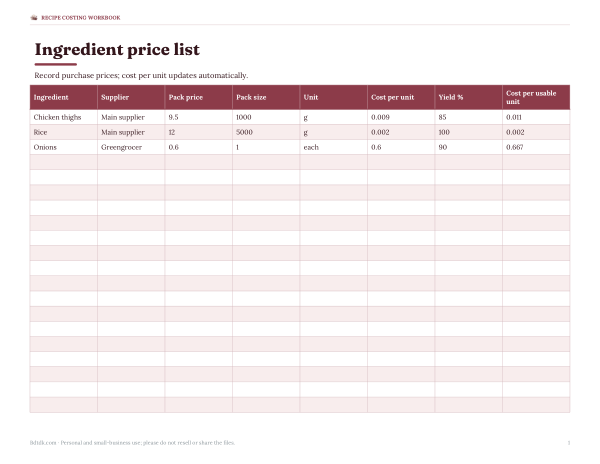
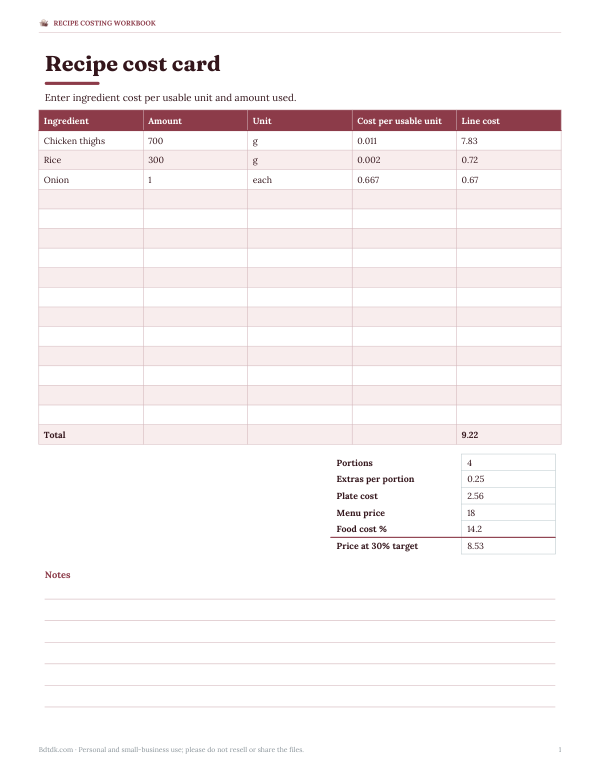
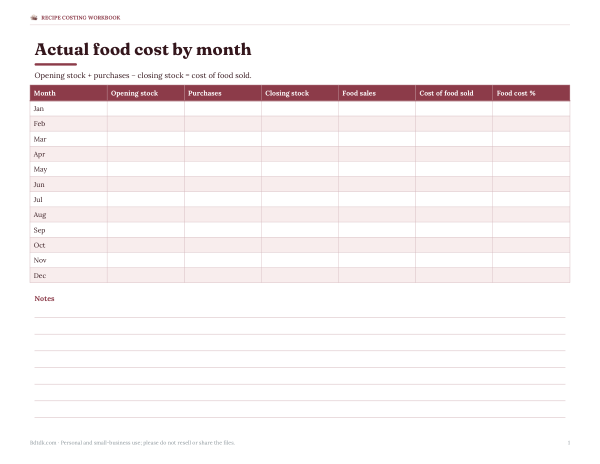
Excel recipe costing workbook with ingredient price list, yield-adjusted recipe cards, menu pricing and food cost %, plus a monthly actual food cost calculator and yield test sheet.
- Ingredient price list (XLSX)
- Recipe cost card (XLSX)
- Monthly actual food cost (XLSX, PDF)
- Yield test sheet (PDF, DOCX, XLSX)
Formats: XLSX, PDF, DOCX. Instant download after payment (link valid 72 hours, up to 5 downloads). AI-assisted: the templates were drafted with AI help and reviewed and laid out before publishing.
$7.00 USD, one-time 4 files · about $1.75 each
- Instant download
- 7-day refund
- Secure checkout by Stripe
7-day money-back guarantee. Full refund within 7 days of purchase, even after you download.
Free sample: Actual Food Cost (PDF, 63 KB)
Full refund within 7 days — see the refund policy and license.
Free printables
Single sheets you can print right now, no sign-up. The full pack adds every sheet in one download plus the editable files.
 Printable Yield Test Sheet
How to calculate food cost
- List every ingredient in the recipe, including oil, seasoning and garnish.
- For each, note the purchase price and the pack size in a unit you can measure — grams, millilitres, ounces or each.
- Enter the amount the recipe uses in the same unit.
- Enter the yield percentage: the usable part after trimming, peeling, bones or cooking loss.
- The calculator works out each line’s cost as price ÷ pack size × amount used ÷ yield.
- Divide the recipe total by the number of portions and add any per-portion extras such as sauces, garnishes or takeaway packaging.
Food cost percentage is plate cost divided by menu price. A $5.40 plate cost on an $18 dish is a 30% food cost.
Why yield matters
You pay for the whole ingredient, but you only serve the usable part. A kilo of whole chicken thighs might give 850 g of trimmed, deboned meat — an 85% yield — so each usable gram costs more than the purchase price suggests. Vegetables lose peel and trim, meat and fish lose bones, skin and cooking moisture, and herbs lose stems. Measure yields in your own kitchen: weigh an ingredient before and after preparation a few times and average the results.
| Ingredient (typical) | Usable yield |
|---|---|
| Onions, peeled | ≈ 90% |
| Carrots, peeled | ≈ 80–85% |
| Whole chicken to meat | ≈ 65–70% |
| Boneless thighs, trimmed | ≈ 85–90% |
| Salmon fillet, skinned | ≈ 90% |
| Fresh herbs, picked | ≈ 60–75% |
These are rough examples; your own tests are more accurate for your suppliers and prep methods.
Target food cost percentages
| Type of operation | Typical food cost % |
|---|---|
| Fine dining | 28–35% |
| Casual dining | 28–32% |
| Quick service / fast casual | 25–30% |
| Pizza | 20–25% |
| Cafés and bakeries | 25–35% |
| Catering | 25–35% |
These are common industry ranges, not rules. A dish with a high food cost can still be profitable if it sells in volume or has a high cash margin; a low-cost dish that nobody orders earns nothing. Look at both percentage and gross profit per plate.
Pricing a dish from food cost
To find a menu price for a target food cost, divide the plate cost by the target percentage. A $4.60 plate cost at a 30% target gives $15.33, which you might price at $15.50 or $15.95 depending on your menu style. Then sense-check against competitors, perceived value and the rest of your menu. Many operators use a mix: high-margin starters, sides and drinks balance mains with higher food cost.
Worked example: chicken curry
A chicken curry for four uses 700 g of thighs from $9.50/kg packs at 85% yield ($7.82), 300 g of rice from a $12 5 kg bag ($0.72), one onion at $0.60 with 90% yield ($0.67), 100 g of curry paste from a $4.20 400 g jar ($1.05), one $1.80 can of coconut milk and half a $1.20 bunch of coriander at 70% yield ($0.86). The recipe costs about $12.92, or $3.23 per portion, plus $0.25 for garnish and naan crumbs, giving $3.48. At an $18 menu price that is a 19.3% food cost; to hit 30% the price could be as low as $11.60.
Keeping costs accurate
- Update ingredient prices when invoices change — especially proteins, dairy and produce.
- Standardise recipes and portion sizes so the costing matches what is served.
- Include small items: oil, salt, spices and garnishes add up.
- Track waste and spoilage; they raise actual food cost above theoretical.
- Compare theoretical food cost with actual (opening stock + purchases − closing stock ÷ food sales) each month.
Theoretical vs actual food cost
The calculator gives theoretical food cost — what a dish should cost if made exactly to recipe. Actual food cost comes from your stock and sales: opening inventory plus purchases minus closing inventory, divided by food sales for the period. A gap of more than a couple of percentage points usually points to over-portioning, waste, theft, pricing errors or recipes that are not followed.
Beyond food cost: prime cost
Food cost is one part of a restaurant’s costs. Prime cost — food and beverage cost plus labour — is often used as a key measure, and many operators aim to keep it around 60–65% of sales. Rent, utilities, marketing and other overheads come out of what remains. A dish that is labour-intensive may need a lower food cost to be profitable.
Privacy
All calculations happen in your browser. Your recipes and prices are not uploaded or stored; use the paid workbook to keep a permanent costing file.
Frequently asked questions
How do I calculate food cost percentage?
Divide the cost of the ingredients in a dish by its menu price and multiply by 100.
What is a good food cost percentage?
Many restaurants aim for about 28–35%, depending on the concept.
How do I price a menu item?
Divide the plate cost by your target food cost percentage, then round and check against the market.
What is yield percentage?
The usable portion of an ingredient after trimming and cooking, as a percentage of what you bought.
Should I include garnish and packaging?
Yes, add them as per-portion extras.
How often should I update recipe costs?
Whenever supplier prices change noticeably, and at least every quarter; review proteins and produce monthly because they fluctuate most.
Is my data saved?
No, everything stays in your browser.